YUMI Py is a portable application that generates multiboot flash discs for Windows and Linux. The software is developed in Python and performs equally well on both systems. I haven’t tested it on Linux, but I’ll assume it works and can put several distributions, installers, and service images on the flash drive. The program will automatically prepare the boot menu. It’s a useful capability if you utilize a single flash drive to install and repair many systems.
The application converts drives to exFAT and can handle files larger than 4 GB without difficulty. All major image formats are supported, including ISO, IMG, and WIM, and photos can be added using drag-and-drop. Persistent storage is provided for compatible Live systems such as Arch, Debian, Fedora, and Ubuntu. Changes will not be lost after a reboot; don’t worry, the author has considered everything.
You can check the flash drive’s readiness without restarting your computer. YUMI Py executes the entire drive in a disposable VirtualBox environment or launches a separate ISO image using QEMU. WHPX on Windows and KVM on Linux are used to accelerate. The distribution can also be installed to a QCOW2 persistent disc directly on a USB stick. Unlike the fast test, this virtual computer saves data and configurations between sessions.
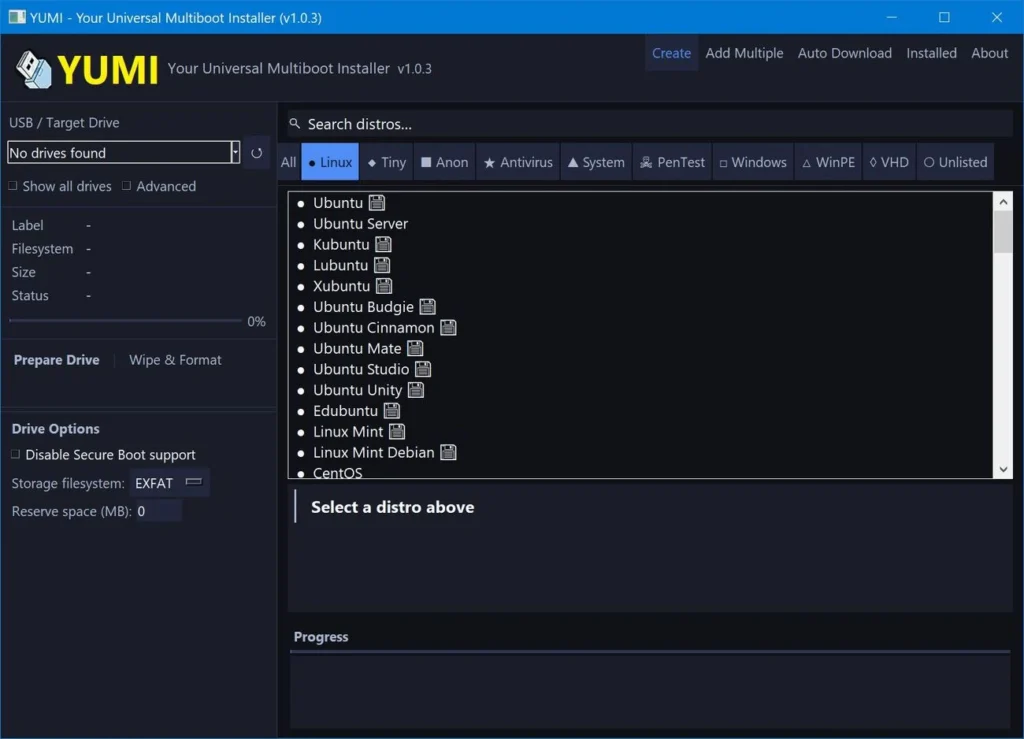
The software can also generate a backup image of the disc, restore it, and clone one flash drive to another with further verification. This is easy; for example, on Linux, the wizard does not allow you to create a new Windows-On-VHD since it requires diskpart and DISM. However, existing VHDs and VHDXs can be added and loaded without issue.
Pros:
- Features include compatibility with Windows and Linux, capability for files up to 4 GB, and the ability to add photos via dragging and dropping.
- Checking the boot with VirtualBox and QEMU
- QCOW2 allows for backup, restore, and cloning of persistent discs on flash drives.
Similar:
Ventoy simplifies adding an ISO to a flash drive and offers fewer built-in tools for virtual machines.
Rufus writes single images flawlessly but is unsuitable for a full-fledged multiboot.
Answers to Questions:
Can I test a flash drive without rebooting?
Yes, VirtualBox and QEMU are suitable for this.
Does YUMI Py work with Linux?
Yes; however, you cannot use the wizard to create a new Windows-on-VHD.