Adobe Acrobat Reader DC: What is it? The Crucial Free PDF Viewer
Let’s discuss the software that is most likely now installed on your computer. Adobe’s PDF technology is the universal language in the huge world of document tools. But in that world, Adobe Acrobat Reader DC is a free, indispensable application that handles the majority of our work. For the past ten years, it has been installed on every computer I’ve owned. It’s the program you have installed right now to read e-books, review reports, and open contracts. The acronym “DC” stands for Document Cloud, suggesting that it can now sync your files between devices. Fundamentally, Reader DC is the dependable workhorse that guarantees a PDF appears precisely as intended on a PC, Mac, or mobile device. We all agree on this digital paper.
Fundamental Goals and Essential Skills
What is its actual function, then? According to my observations, Adobe Acrobat Reader DC’s main goal is to be the most reliable, feature-rich free PDF viewer available. Its superpower is the flawless representation of everything in a PDF, including intricate layouts, elegant fonts, pictures, and even interactive forms. However, it goes beyond simply examining files. It has a lot of power for a free tool. Large papers can be easily navigated, text can be searched in a matter of seconds, precise printing is possible, and file sharing is safe. The PDF for your flight or that crucial invoice will never be stuck on one device, thanks to integration with cloud storage services like Dropbox, OneDrive, or Adobe’s own Document Cloud.
Does Acrobat Reader DC Actually Cost Nothing?
I’m constantly asked this question. The answer is unquestionably affirmative, but with very specific limitations. Downloading, installing, and using Adobe Acrobat Reader DC for its basic functions—opening, viewing, printing, and commenting on PDFs—is totally free. Reading a PDF will never cost you anything. Completely stop. Adobe, however, carefully distinguishes between “viewing” and “creating/editing.” Do you want to redact sensitive information, change text permanently, or convert a PDF to a Word document? Acrobat Standard and Pro, the commercial versions, are the only ones with those features. Reader DC will frequently let you *click* on these tools before gently—and sometimes not so gently—nudging you to upgrade. In my opinion, it serves as both a demo for the potent, expensive suite and an incredibly capable free viewer.
Important Features & Tools: More Than Just PDF Opening
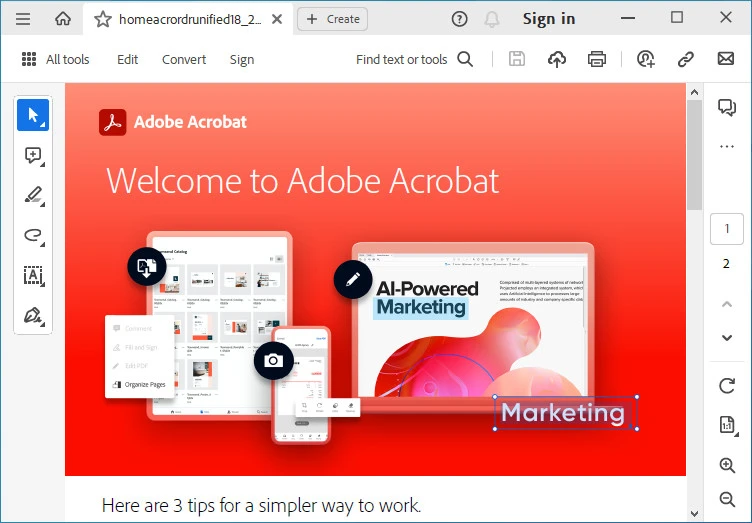
Referring to Adobe Acrobat Reader DC as merely a “PDF viewer” is like calling a Swiss Army knife a blade. With its extensive toolkit for real-world document interaction, you may collaborate and perform simple tasks without ever opening your wallet.
Tools for Viewing and Navigating
Reader DC really excels during the viewing experience. It effortlessly manages large, graphic-rich files. I frequently use the various viewing modes: Two-Page for a magazine-like experience, Single Page for concentrated reading, and Scrolling for lengthy instructions. Bookmarks and page thumbnails are immediately accessible through the side navigation window. Its search feature is quite quick. Additionally, the Read Out Loud tool has strong accessibility features, making it an inclusive option I truly value.
Features for Commenting and Annotation
At this point, the software becomes a hub for collaboration. You are both a reviewer and a passive reader. To provide visual feedback, you can add sticky notes with detailed notes, highlight text, and use drawing tools such as shapes and arrows. For years, I have edited draft essays and designed mockups using these features. The finest aspect? On top of the original PDF, these annotations are non-destructive layers. Gather everyone’s notes, distribute your marked-up file, and keep the original document intact.
Electronic Signatures and Completing Forms
Just this function has prevented me from making numerous journeys to the printer and scanner. Reader DC well supports digital signatures. Your signature can be typed, sketched, or uploaded as an image. Is it enforceable by law? Absolutely, for the majority of daily uses. Moreover, interactive PDF forms are completely supported. It’s easy to complete internal checklists, tax papers, and application paperwork. You can check boxes, tab through fields, and save the finished form. It’s one of those elements that seem unremarkable but make modern living much more efficient.
A Comprehensive Analysis of Adobe Acrobat Reader DC vs Adobe Acrobat Pro
This is the crux of the choice. You can save time and money by understanding the distinction between a free reader and a paid pro. Given that I use both for personal and professional work, here is my breakdown.
Comparison of Features and Price
90% of people should utilize Adobe Acrobat Reader DC. It is fully functional and free if you need to read, evaluate, sign, and fill out PDFs. A professional productivity suite is Adobe Acrobat Pro DC. If you frequently create documents from scans or web pages, modify existing PDF text, convert files for editing, or implement high-level security, you’ll need it. For positions in administration, finance, law, or academics, the subscription is a business expense. For everyone else? Most likely, reader DC is sufficient.
Benefits and Drawbacks of Adobe Acrobat Reader DC
Benefits for the majority of users
- The Universal Standard: It consistently opens any PDF. It’s invaluable for document sharing, and I’ve never experienced a compatibility problem.
- Completely Free Core Use: There is no cost for viewing, printing, annotating, or signing. Its greatest advantage is this accessibility.
- Great Annotation Toolkit: I rarely feel constrained during review cycles because the commenting tools are so extensive.
- Cross-Platform Consistency: On Windows, macOS, iOS, and Android, the experience is nearly identical. Everywhere I go, my sticky notes sync and look the same.
- Security and Trust: It receives regular security updates as an approved Adobe product, which is important given that the format occasionally serves as a malware vector.
Restrictions to Take Into Account
- The Upgrade Nudge Is Persistent: There are many Acrobat Pro prompts and advertisements throughout the UI. It can be distracting, but it’s the cost of being free.
- The most important one is No Creation or Conversion. A Word document cannot be converted to a PDF, nor can a PDF be converted back into an editable document. You’re in a viewing compartment.
- Basic Tools Feel Gated: It can be annoying when simple actions like permanently turning a page or merging two PDFs prompt an upgrade.
- Possibility of Being a Resource Hog: Reader DC is a feature-rich program in contrast to more basic options like Sumatra PDF. I’ve discovered that it can use a significant amount of RAM when multiple huge PDFs are open.
- Limited Cloud Sync in the Free Tier: Although it can connect to cloud storage, a subscription is required for more advanced Document Cloud synchronization and online collaboration features.
Adobe Acrobat Reader DC remains the clear winner for reliable, free PDF interaction. It offers enough power for most people’s everyday digital paperwork. Its deliberate limits mark the boundaries of Adobe’s free product. Do I primarily *use* PDFs, or do I need to *make* and *remix* them? This is a question you should consider before deciding on a Pro subscription. If it’s the former, Reader DC is the ideal, reasonably priced (read: free) solution for the task.