X-Ability, a Japanese software business, developed Winmostar, an integrated molecular modeling and materials simulation software. The software provides a simple graphical user interface (GUI) for complicated computational chemistry and materials science simulations. Winmostar connects experimental researchers with modern computational tools by providing an integrated environment for building molecular structures, performing quantum-chemical calculations, and visualizing results.
Main objective
Winmostar is intended to make molecular modeling, quantum chemistry, and molecular dynamics (MD) simulations accessible to researchers, educators, and engineers who are not computational scientists. The software has a straightforward workflow from molecular design to data analysis and supports a variety of computational engines and file formats.
Key Features:
- Graphical User Interface (GUI).
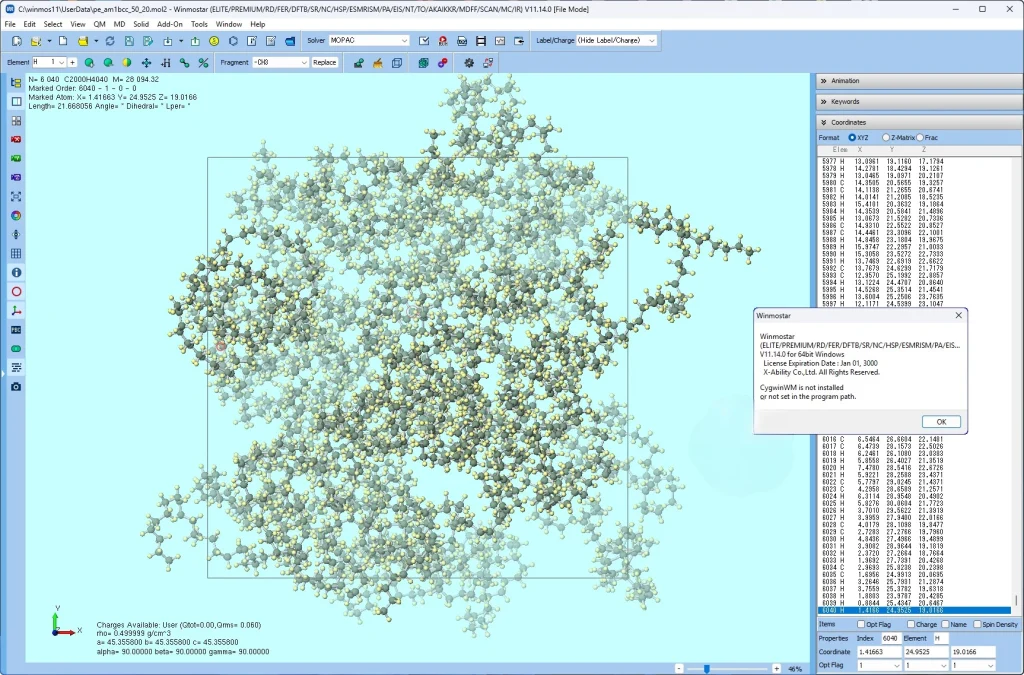
Winmostar’s distinguishing feature is its simple interface, which lets users create molecular structures, clusters, and crystal lattices using a 3D visual editor.
Key features:
Winmostar stands out for its user-friendly interface, which enables customers to:
- Create molecular structures, clusters, and crystal lattices with a 3D visual editor.
- Chemical files can be imported and exported in the following formats: XYZ, PDB, CIF, MOL, and Gaussian input files.
- Adjust simulation parameters using guided forms rather than manually editing text.
- The visualization of molecular orbitals, electron density, and potential energy levels.
- The graphical user interface (GUI) design is intended to reduce the learning curve for novice users while offering expert-level flexibility for advanced researchers.
- Support for quantum chemistry.
Winmostar communicates with numerous quantum chemistry calculation engines, allowing the following:
- Geometry optimization, frequency analysis, and search for transition states.
- Electronic structure investigation includes molecular orbitals, charge distribution, and density of states (DOS).
- Compatible with popular programs such as Gaussian, ORCA, GAMESS, and others.
- Winmostar allows users to prepare input files, perform calculations, and view the results.
- Molecular Dynamics (MD) Simulation.
The software can also do traditional molecular dynamics simulations, making it useful for materials and biomolecular research. It has the following features:
- Integration of MD engines like LAMMPS and GROMACS.
- Tuning force fields (such as AMBER, OPLS, and CHARMM) for organic, inorganic, and hybrid systems.
- Real-time tracking of MD trajectories and visualisation of system evolution over time.
- Post-processing methods for examining structural characteristics, radial distribution functions, and energy profiles.
- Material Modeling
Beyond molecular chemistry, Winmostar provides solid-state and materials modeling, including:
- The creation and manipulation of periodic crystal formations.
- Surface and interface modeling (plates, flaws, and absorption tests).
- Visualization of the band structure and state density in electrical materials.
- Polymer, catalyst, and nanostructure simulations can be tuned using these tools.
- Visualization & Analysis
One of Winmostar’s key advantages is its sophisticated visualization engine:
- Displays molecular geometries, atomic motions, and three-dimensional scalar fields (such as electrostatic potentials).
- Creates high-quality photos and animations for publication and presentation.
- It provides analytical tools for data mining, graphing, and correlation analyses.
- Automation and Scripting
Winmostar offers advanced users the following automation features:
- Multiple calculations can be processed in one batch.
- Parameter permutation (for example, between different base sets or chemical configurations).
- Scripting features for extending or customizing workflows.
- This makes it ideal for high-throughput computational screening and large-scale computational chemistry classroom instruction.
Applications
Winmostar is utilized in several sectors of study and industry:
Drug design includes molecular docking, structural analysis, and drug-receptor interaction modeling.
Materials Science involves simulating catalysts, semiconductors, polymers, and nanomaterials.
Energy research focuses on battery materials, hydrogen storage devices, and photovoltaic chemicals.
Education: Providing a practical platform for teaching molecular modeling and computational chemistry.
Benefits
- Ease of use: makes it easier to set up and run complex simulations.
- Integration combines numerous computer tools into a single workflow.
- Visualization: Offers high-quality 3D visualization and analysis.
- Multiscale capability: Can simulate at both the quantum and classical levels.
- Educational value: Suitable for students and professionals studying computational methods.
System compatibility
WinMoStar is primarily designed for Windows systems; however, it can interface with Linux-based solutions via remote or local execution. The program is compatible with both 32-bit and 64-bit architectures and can be integrated into HPC (High Performance Computing) environments as needed.
Development and Evolution
- X-Ability has focused on improving Vinmostar’s compatibility with third-party computational routines throughout time.
- Graphic visualization has improved in terms of speed and accuracy.
- Introducing machine learning-based tools for data analysis and molecular prediction.
- Improved usability for both new and experienced computational scientists.
Conclusion
X-Ability Winmostar is a versatile, comprehensive, and user-friendly molecular modeling suite that combines theoretical and practical research. The software combines quantum chemistry, molecular dynamics, and materials simulation capabilities into a unified visual interface, allowing scientists and engineers to examine molecular and material phenomena more efficiently and precisely.